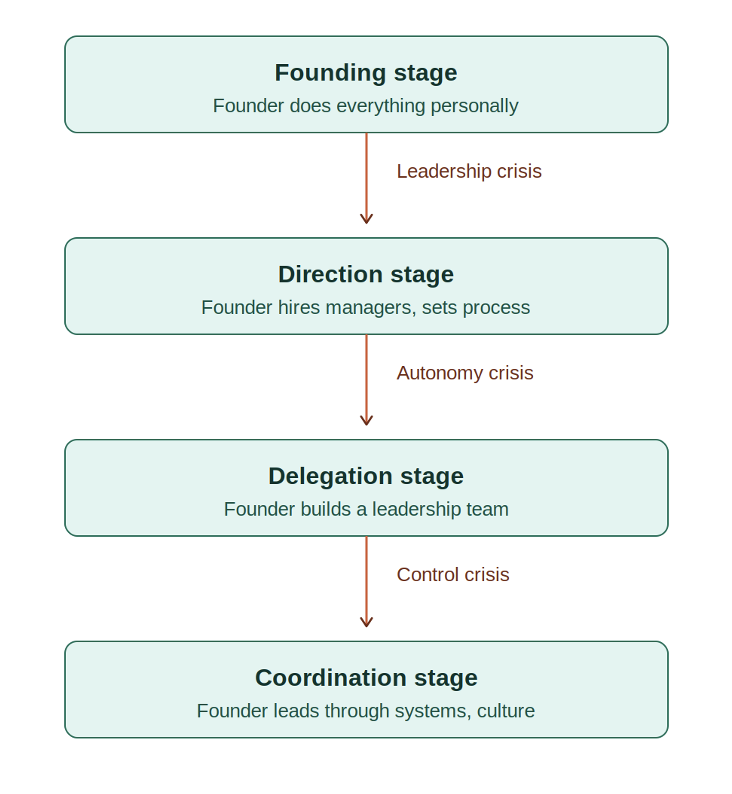
The Four Stages of Founder to CEO Transitions…….
…. and the crises that can occur at each stage
Every founder eventually runs into the same wall. A way of working that got the business to the next milestone quietly stops working — not because the founder got worse at their job, but because the company outgrew the way they were running it. This post walks through four such transitions, drawing on four books and papers that each captured a different piece of the puzzle: Larry Greiner's organizational growth model, Eric Flamholtz and Yvonne Randle's Growing Pains, Noam Wasserman's The Founder's Dilemmas, and Rachel Turner's The Founder's Survival Guide.
These sources come at the same topic from different angles. Greiner was writing organizational theory in 1972. Flamholtz and Randle were consulting with mid-market companies decades later. Wasserman ran a ten-year quantitative study of startup founders. Turner coaches founders directly through their scale-up challenges. But laid on top of each other, they describe the same four-stage arc — and each one adds something the others don't.
Stage 1: Founding — the leadership crisis
At the beginning, the company is the founder. In Greiner's language, this is “growth through creativity”: the organisation is flat and everyone has access to the boss, and informal communication works fine because there aren't many staff. Flamholtz and Randle call the same period the “New Venture” stage, running roughly from founding until the company reaches about $1 million in revenue, with nearly all energy going into identifying a market and building the first product.
The breakdown is structural, not personal. As the company grows, informal processes need to be formalised, and the founder's improvisational style — however well it worked at ten people — starts to fail at fifty. Greiner's term for this moment is the leadership crisis: the business becomes too big for one person's judgment and presence to hold together.
Turner names the founder's mode at this stage “brave warrior” — the instinct-driven, hands-on style that built the company, which starts turning into a liability rather than an asset as things scale. Wasserman frames the same moment as the opening move in what he calls the Rich vs. King dilemma: the first real fork between maximizing the value of the business and maximizing the founder's personal control over it. As he puts it, founders must be honest with themselves about which one they actually want, because from here on the two increasingly pull apart.
What the founder has to do differently: stop being the sole decision-maker. Bring in a first layer of managers. Start writing down what used to live only in their head.
Stage 2: Direction — the autonomy crisis
Once a founder survives the leadership crisis, the fix usually looks like this: promote from within or hire professional managers from outside, install budgets and targets, and get some actual structure into the place. This is Greiner's “growth through direction” phase. Flamholtz and Randle's parallel stage is “Expansion” — the period of rapid growth that follows once a company has proven its product and market fit.
The catch is that this fix has a shelf life too. The founder is often still the one really pulling the strings, even once middle managers are technically in place — a puppet master behind a structure that looks delegated but isn't. Formal procedures get installed, but delegation hasn't yet become automatic, and people end up overloaded with work waiting on decisions that haven't actually moved.
This produces the autonomy crisis: the managers who were promoted within or recently hired to help the founder scale start chafing against how little real decision-making authority they've actually been given, and the founder becomes the bottleneck they were trying to eliminate.
What the founder has to do differently: genuinely let go of decisions, not just the tasks around them. This is a harder version of the same lesson from stage one — hiring people is easy; trusting them with real authority is the actual test.
Stage 3: Delegation — the control crisis
Founders who make it through the autonomy crisis usually do it by properly delegating: middle managers get real authority, the founder steps back from day-to-day operations, and the top team shifts to a more strategic view of where the company is headed. Flamholtz and Randle call this “Professionalization” — the stage where the company builds out real operational and management systems rather than running on founder instinct.
But delegation done well eventually creates its own problem. Divisional or functional leaders, now genuinely empowered, start pursuing their own priorities — sometimes in directions that pull against each other or against the center. This is Greiner's control crisis: the danger that the various parts of the company head off on their own, threatening to pull the business apart just as the founder finally stopped micromanaging it.
This is also, in Wasserman's data, one of the sharpest points of founder turnover. On average, about three in four original founders end up being replaced as CEO by their own board — often precisely because the skills that got a company through the delegation stage aren't the skills a board trusts to run a much larger organization. Wasserman's line for this mismatch: the world's best speedboat captain can't necessarily pilot an oil tanker.
Turner's term for the founder who's made it here is “considered architect” — someone who has started designing the organization deliberately rather than running it on instinct, but who hasn't yet found the higher-altitude version of leadership that the next stage demands.
What the founder has to do differently: build the coordinating mechanisms — shared goals, cross-functional processes, a real leadership team that talks to each other and has matured the way they handle and resolve conflict — that keep an increasingly autonomous organization pointed in the same direction.
Stage 4: Coordination — leading through systems and culture
The companies that make it this far stop being run through any one person's direct oversight, whether that's the founder or a layer of managers underneath them. Greiner calls this “growth through coordination and monitoring” — a stage marked by more centrally coordinated systems, cross-unit collaboration, and incentives tied to company-wide performance rather than any single team's numbers. Flamholtz and Randle's version of this stage, “Consolidation,” is where the last of their pyramid's foundational tasks — building real operational systems, management systems, and deliberately managing the corporate culture — finally comes together as a coherent whole rather than a patchwork.
Turner's name for the founder at this stage is “wise monarch”: someone who leads primarily through the culture, systems, and structures they've built, rather than through direct involvement in most decisions. It's the furthest point from where the founder started, and for many founders the hardest identity shift of the four — moving from being needed everywhere to being needed almost nowhere day-to-day, while still being accountable for everything.
Greiner's model doesn't stop here — growth through coordination eventually runs into its own crisis of excess bureaucracy, and later phases involve growth through partnerships and external alliances. But for most founder-CEOs, stage four is the point where the original question — can this person run the company they started? — finally gets a settled answer, one way or the other.
A caution: don't over-rotate into ‘Manager Mode’
Everything above describes a founder progressively giving things up — control, involvement, the instinct-driven style that got the company started. Taken too literally, that arc reads as “become a professional manager as fast as possible.” Paul Graham's 2024 essay “Founder Mode,” written after a talk by Airbnb's Brian Chesky, is a useful corrective to that reading.
Graham's argument is that conventional scaling advice — hire good managers, hand them a subtree of the org chart, and stay out of it — works for professional managers but is often the wrong advice for a founder-CEO. Treating each department as a black box you don't look inside, he argues, is how founders end up governing a company they can no longer actually see. His examples lean on Steve Jobs, who kept running skip-level meetings and an annual retreat with people well below his direct reports, deep into Apple's scale — deliberately keeping a channel below the management layer open, rather than only ever hearing the company through his executives' summaries.
The caution isn't “ignore the four stages above.” Delegation, coordination, and systems are still real and still necessary — Flamholtz and Randle's whole pyramid depends on them. The caution is narrower: don't let “I'm delegating” quietly become “I no longer have direct, unfiltered visibility into how the company actually runs.” The skill isn't picking Founder Mode or Manager Mode once and staying there — it's knowing which one a given decision calls for, stage by stage.
Founder-mode habits worth keeping at each stage
Founding stage. There's little risk of over-delegating here — the founder is the company. The real risk is the opposite one: waiting too long to introduce any structure at all because founder mode is all that's been tried.
Direction stage. As the first layer of managers goes in, keep one direct channel to the frontline open — a recurring skip-level, office hours, or a rotating sample of raw work (support tickets, sales calls, code reviews) reviewed personally rather than only through a manager's summary. The point isn't to override the new managers; it's to keep your own holistic picture of the company first-hand.
Delegation stage. As operational authority spreads to a real leadership team, decide deliberately which small number of company-defining calls you still make yourself — product taste, pricing philosophy, the hiring bar for future executives — and delegate the rest genuinely. An annual all-hands or retreat where you engage directly with people several levels down, in the spirit of Jobs' retreats, keeps that channel alive without undermining the managers now running day-to-day operations.
Coordination stage. Make founder-mode deep-dives a known, scheduled part of how the company runs, rather than a surprise intervention that reads as a vote of no confidence. A founder who spot-checks any team, any time, as an accepted norm preserves visibility without it landing as micromanagement — the difference is entirely in whether people were told to expect it.
A word for the other leaders in the room
None of this happens to the founder alone. Every one of these transitions is also happening to the team leaders, managers, directors, and eventual executive team the founder is promoting, hiring and delegating to — people who are themselves trying to grow into bigger roles, develop their own leadership style, and earn real authority. A founder who swings between founder mode and manager mode without explaining which one they're in can make that growth much harder: a leader who was just handed a mandate to “own” a function can reasonably feel blindsided when the founder suddenly parachutes into their team's work or have their decision over-ruled without a reasonable, evidence based debate about options considered.
The practical fix is mostly about making the switch legible rather than eliminating it. Say out loud when you're going deep on something and why — “I'm getting into the weeds on this one because it's close to the product's core, not because I don't trust how you're running the team.” Give leaders real, unambiguous scope elsewhere, so founder-mode moments don't quietly become the norm everywhere. Use skip-levels and deep-dives as listening exercises, not as backchannels for issuing instructions that bypass the manager in the room. And in 1:1s with those leaders, ask not just for status updates but where they want to grow next — the same evolution being asked of the founder is being asked of them, and it deserves the same patience.
The thread underneath all four sources
Strip away the different vocabularies and the same pattern repeats: a working mode gets the company to the next size, then becomes the very thing holding it back, and the founder has to give something up — control, involvement, a way of operating that used to be a strength — to get to the next stage. Greiner supplies the structural logic for why this keeps happening. Flamholtz and Randle supply the organizational-development checklist for what needs to be built at each stage. Wasserman supplies the sobering data on how often founders don't survive these transitions as CEO. And Turner supplies the language for what it actually feels like to be the person going through it.
Sources referenced
● Larry E. Greiner, “Evolution and Revolution as Organizations Grow,” Harvard Business Review, 1972 (revised 1998)
● Eric G. Flamholtz and Yvonne Randle, Growing Pains: Transitioning from an Entrepreneurship to a Professionally Managed Firm, 2015
● Noam Wasserman, The Founder's Dilemmas: Anticipating and Avoiding the Pitfalls That Can Sink a Startup, Princeton University Press, 2013
● Rachel E. Turner, The Founder's Survival Guide: Lead Your Business from Start-up to Scale-up to Grown-up, 2022
● Paul Graham, “Founder Mode,” paulgraham.com, September 2024
Credit to Claude AI for supporting the crafting of this blog.